
The future of accelerator-based high-energy particle physics is at a crucial juncture in Europe, and globally. CERN’s High-Luminosity Large Hadron Collider is set to complete its programme by the end of 2041 and work is underway to identify the next flagship successor project.
Last week, 12 December, it was announced that the electron–positron Future Circular Collider (FCC-ee), a 90.7km next-generation particle accelerator, has been recommended as the preferred option of the European Strategy for Particle Physics (ESPP) to be CERN's next flagship collider.
This recommendation will feed into a final decision by CERN Council on which new accelerator project it intends to pursue.
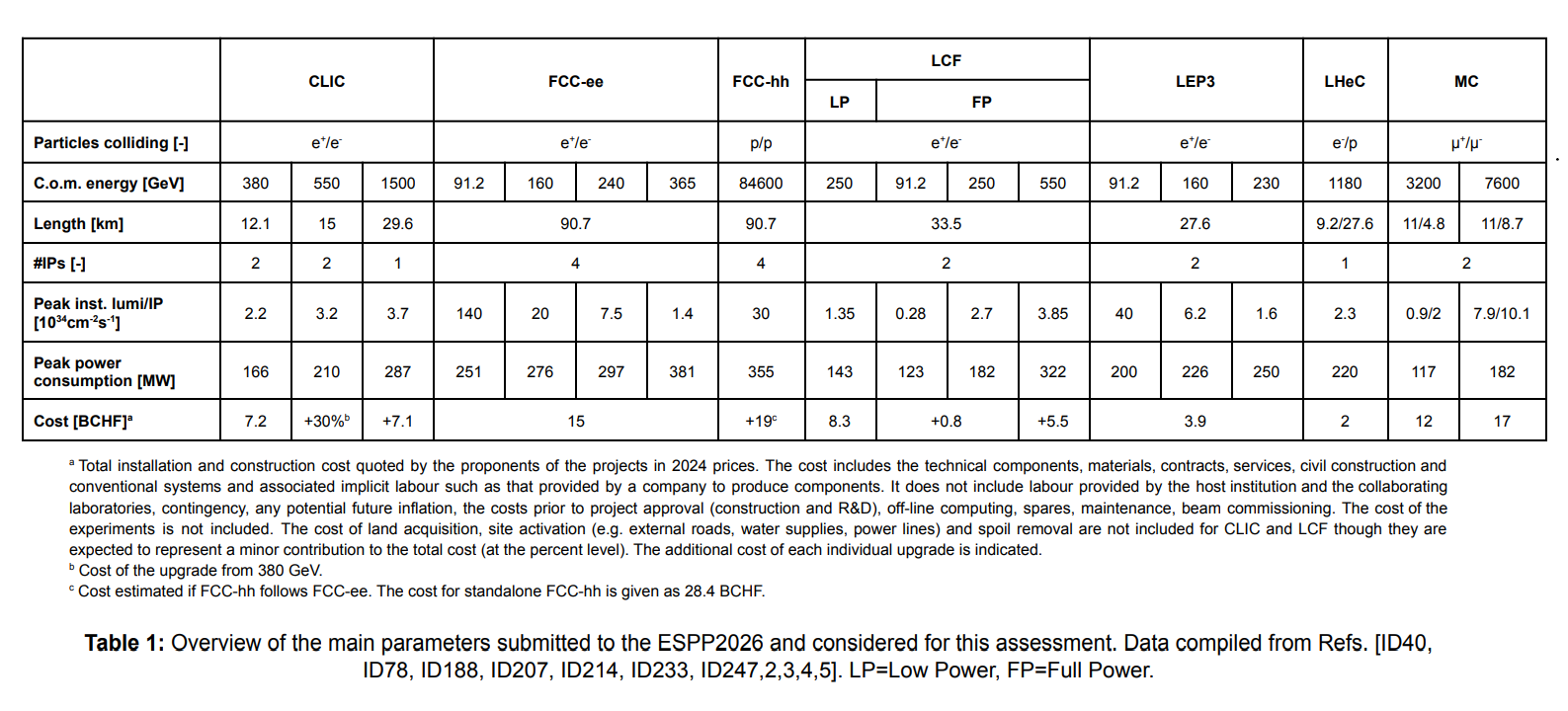
Ahead of the ESPP recommendation, a working group of the European Strategy Group (ESG), which coordinates the ESPP and its updates, published a comparison of the different future accelerator projects that had submitted proposals to the ESPP.
The working group (WG2a) assessed six possible options:
- The Linear Collider Facility (LCF)
- The Compact Linear e+e− Collider (CLIC)
- LEP3
- The Muon Collider (MC)
- The Large Hadron electron Collider (LHeC)
- The FCC-ee and the FCC-hh
In this interview, the two convenors of ESG WG2a, Gianluigi Arduini from CERN and Philip Burrows from the John Adams Institute, Oxford University, explain the work, the results and the importance of the study.
To find out more about three of the proposed accelerators, you can read our interviews with representatives of CLIC, the FCC and the MC.
What was the main purpose of the ESG’s study of future accelerator projects?
The ESG was charged by CERN Council to prepare an updated Strategy for European particle physics in light of progress and developments in the field since the previous strategy was completed in 2020. A dedicated working group, ‘WG2a’, was specifically charged to evaluate the status of the proposals for large-scale collider projects submitted to the ESPPU as candidates for realisation at CERN as the next major collider in Europe. The group was asked to review for each project its scope, the uncertainties in performance, schedule and cost, risk profiles, and site preparation, as well as technical feasibility including technology readiness levels (TRLs), R&D requirements, and needs for test facilities.
What are some of the main findings of the report? Anything surprising?
The report provides an assessment for each project of the aspects that were reviewed, including a high-level overall summary of the findings. This allows relative comparison among projects of their state of readiness and those areas in which further work would be required in order to progress in the respective areas.
The report gives a TRL for various technologies required for the proposed accelerators. Is having a low TRL a negative or positive point in this instance?
The report presents a snapshot assessment of the TRLs as they are today. Each major system has been assessed based on the information submitted to the ESPPU, benefitting also from the comprehensive review of the Technology Roadmap activities made in early 2025 by an expert committee set up by the Laboratory Directors’ Group. Given additional resources, R&D can be done to enable low-TRL systems to progress to a higher TRL as their development matures. All of the project submissions included some technical systems that are, today, at a lower TRL than would be suitable for production readiness.
Has one of the proposed projects stood out as being a better candidate?
Nine criteria were considered, and each project was assessed against each criterion. The FCC-ee project achieved overall the highest assessment, which reflects the recent successful completion of the FCC-ee Feasibility Study. Other projects, with differing levels of maturity, were found to need further work in the respective areas in order to reach a comparable state of maturity as FCC-ee.
How will this report now be used going forwards?
The report formed input into the ESG deliberation process. The preliminary findings were shared with the community, feedback was received, and the conclusions were presented and discussed at the recent ESG meeting in Ascona. Hence the report provided essential information, alongside considerations of the physics potential, to enable the ESG to arrive at its recommendations for the Strategy Update.
How is this report different from the one put together by the Future Colliders Comparative Evaluation - Working Group?
The Future Colliders Comparative Evaluation Group report provided an invaluable foundation for the subsequent work of ESG WG2a. In addition, several external experts were co-opted into WG2a to provide independent advice based on their broad experience of large accelerator projects. Using the ESPPU input documents as a basis, WG2a deliberated on each large collider project and generated a set of specific questions that were sent to the respective proponents to allow clarification of the relevant issues. The findings for each project were then discussed before the assessments against the criteria were performed. In that sense the WG2a report went beyond the scope of the Comparative Evaluation Working Group report in presenting informed relative assessments of the projects.
Are any other comparison reports planned, for example on the societal, political, financial impact / relevance of the different projects?
Several projects have already begun exploring aspects such as societal relevance, long-term impact, and financial considerations within their own study frameworks. These efforts are valuable contributions to the broader discussion, and future comparisons may build on this emerging work as it continues to develop.